Let me show you around
Observatory Park
The blocks around a 10-acre park just east of the University of Denver, with an 1890s red sandstone observatory in the middle. Big two-story houses from the 1890s sit on wide lots among postwar ranches and newer infill.
Live listings on compass.com. Send me any address and I’ll tell you what to look for.
Winter sun
Which driveways stay iced in December and which back yards keep the afternoon. Worth knowing before you fall for a house.
See how the winter sun falls on Observatory Park (opens in new tab)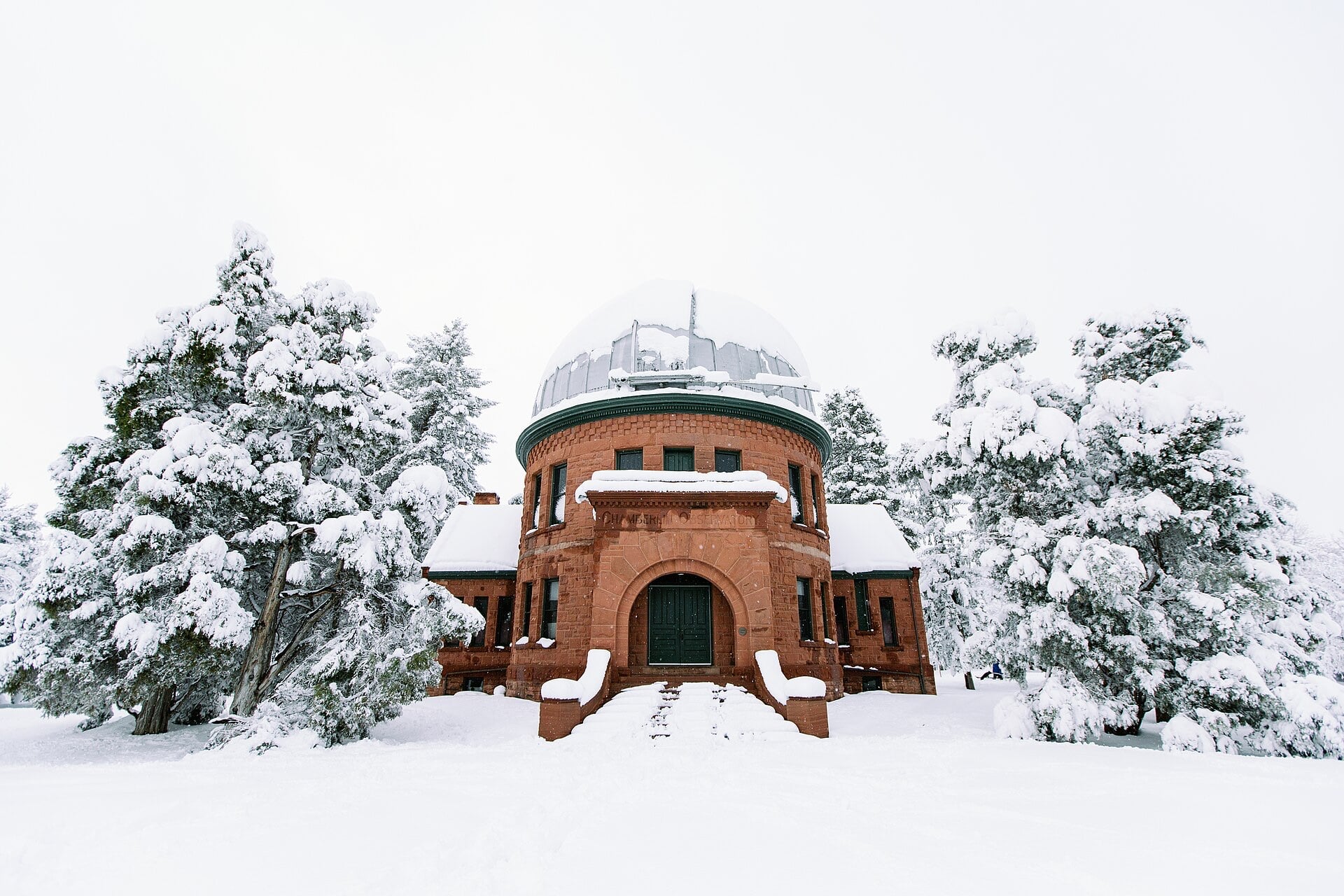
Living in Observatory Park
Observatory Park isn't one of Denver's official neighborhoods. It sits within University Park, and the name covers the blocks around the park, just east of the University of Denver campus. The park fills the stretch between Warren and Iliff Avenues along Fillmore Street.
How the campus and observatory started
In 1886 the University of Denver's backers picked this prairie, well past the city limits, for a new campus. Elizabeth Iliff Warren had made a permanent campus away from downtown the condition of her gift to the university. Potato farmer Rufus Clark donated the land, with terms that included tree planting, a street grid and a ban on making or selling alcohol.
Chamberlin Observatory was the university's first official structure here. Humphrey B. Chamberlin, a real estate promoter and amateur astronomer, pledged $50,000 for it in 1888, and it was done by 1891. Professor Herbert Howe guided the design and had the southern half of the park enlarged, so the road would sit farther away and its traffic wouldn't shake the telescope.
The observatory and the park around it
Robert Roeschlaub designed the building in rusticated red sandstone, Richardsonian Romanesque, with a domed rotunda. The 20-inch refracting telescope inside has a lens by Alvan Clark & Sons and saw first light in 1894. The university still runs it. The Denver Astronomical Society hosts public nights through the year, with tickets sold ahead because seats are limited, and sets up small telescopes on the lawn for free monthly open houses.
The park covers 10.4 acres and has been designated city parkland since 1956. It has four unlit tennis courts (one for drop-in play, three by permit), a softball diamond, a turf multi-use field and a turf area set up for 20 volleyball nets.
Two-story originals and a lot of rebuilding
University Park filled in slowly, so the streets near the park mix eras. The first houses were brick Queen Annes. Foursquares came in the 1890s, bungalows as early as 1900, and revival styles filled open lots after World War I. Early owners tended to build substantial two-story houses near the north end of lots of a quarter acre or more, and a few still have their carriage houses. Professor Howe's 1891 house at 2201 S. Fillmore once had a boardwalk to the observatory. Fitzroy Place at 2160 S. Cook is a Richardsonian Romanesque mansion built for Elizabeth Iliff Warren between 1891 and 1893, now a National Historic Landmark.
Much of the wider neighborhood is one-story tract housing from the 1950s and 1960s plus newer infill, and smaller older houses are often enlarged. If you're shopping here, expect mostly postwar ranches, enlarged houses and new builds. The early houses on big parcels are the exception, and many of them are covered by the district below.
The 2024 historic district
In April 2024, City Council unanimously created the University Park Historic District: 19 structures scattered across the blocks east of campus, with Observatory Park at the center. The observatory, Howe's house and Fitzroy Place are all in it. If you buy one of them, the exterior has to be maintained, and permit work like a roof replacement goes through design review first. Painting or adding storm windows doesn't. Everything else nearby is outside it, so ask early whether a specific address is on the list.
Where to eat and how to get around
On the far side of campus, Jerusalem at 1890 E. Evans sells hummus, falafel and grilled meats until 3 a.m. and was Westword's Best of Denver pick for Middle Eastern food in 2025. Tacos El Metate, at 2060 S. University Blvd., does street-style tacos and is on 5280's 2026 list for the neighborhood.
Streetcars ran here until 1950, and light rail came back in 2006. University of Denver Station, at 1901 E. Buchtel Boulevard, is on RTD's E and T Lines and the 24 bus route, with 540 parking spaces.
FAQ
Is Observatory Park an official Denver neighborhood?
No. It sits within University Park, and the name covers the blocks around the park between Warren and Iliff Avenues, east of the University of Denver.
Can you look through the Chamberlin Observatory telescope?
Yes. The Denver Astronomical Society runs ticketed public nights through the year, and seats are limited. It also holds free monthly open houses with small telescopes on the lawn.
What kind of houses are near Observatory Park?
Much of it is one-story tract housing from the 1950s and 1960s and newer infill, and smaller older houses are often enlarged. Mixed in are substantial two-story houses from the 1890s and early 1900s, some on lots of a quarter acre or more.
Is Observatory Park a historic district?
Part of it. The 2024 University Park Historic District covers 19 scattered structures, including the observatory and Fitzroy Place. Owners of those buildings need design review for permit work like a new roof.
What's in the park besides the observatory?
It covers 10.4 acres, with four unlit tennis courts, a softball diamond, a turf multi-use field and a turf volleyball area.
Is there light rail nearby?
Yes. University of Denver Station, at 1901 E. Buchtel Boulevard, is on RTD's E and T Lines and has 540 parking spaces.
Where do you eat around here?
Jerusalem, on East Evans Avenue on the far side of campus, is open until 3 a.m. Tacos El Metate is on South University Boulevard.