Let me show you around
Country Club
Big early 1900s houses just north of the Denver Country Club, on parkways with planted medians and on the curving, sidewalk-free lanes of Park Lane Square. Much of it is a landmark district, with Mediterranean gateways along 4th Avenue.
About 87% of homes here were built before 1940, median 2,670 sq ft. What to check on houses like these
Live listings on compass.com. Send me any address and I’ll tell you what to look for.
Winter sun
Which driveways stay iced in December and which back yards keep the afternoon. Worth knowing before you fall for a house.
See how the winter sun falls on Country Club (opens in new tab)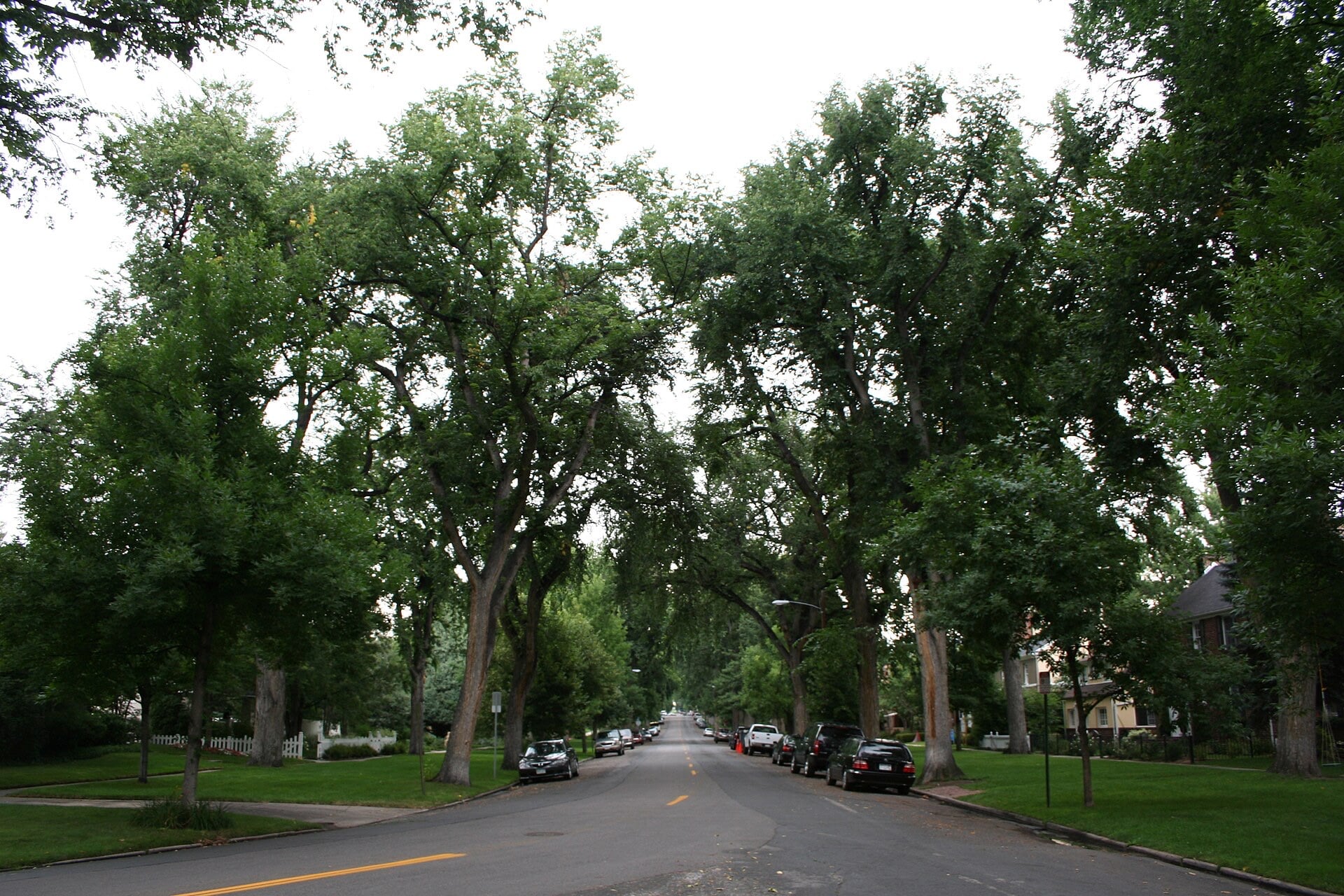
Housing stock: Denver Assessor open data, 2026-09-19.
Living in Country Club
Country Club sits in central Denver between Downing Street on the west and University Boulevard on the east, with Cherry Creek along the south edge. The north edge is 8th Avenue west of York Street and 6th Avenue east of it. The private Denver Country Club takes up the creek side, and the Cherry Creek neighborhood starts across University. The best-known part is the Country Club Historic District, which has 380 residences, mostly on large lots.
How it started
The Denver Country Club dates to 1887 and began around horse racing. In 1902 it bought 120 acres along Cherry Creek, and on the same day the Fourth Avenue Realty Company was set up to buy the land to the north and sell it as house lots. William E. Fisher drew the plan, using Frederick Law Olmsted's ideas about landscaped parkways. Early deeds on Franklin Street set a minimum house cost of $4,500 and a three-foot limit on fences.
Four subdivisions, four kinds of street
The houses went up in pieces, and each piece still looks a little different. Park Club Place, filed in 1905 and 1907 and running from Downing east to Humboldt, is the oldest, with Victorian houses, wide front or wraparound porches and converted carriage houses. Country Club Place, filed in 1906 from Humboldt to High, got the wide parkways with planted medians and tree lawns. East of High, Country Club Annex took shape between 1924 and 1927, with wide lots, sidewalks and tree lawns but no parkways. Tudor-inspired houses are more common there than Mediterranean ones.
Park Lane Square, filed in 1926 between High and University, from 4th up to 6th, breaks the pattern. Landscape architect Saco DeBoer swapped the straight grid for circles, so you get narrow curving streets with no sidewalks and no alleys, and 58 big lots. English-style gates mark its entrances, and Fisher's Mediterranean gateways stand along 4th Avenue. If you want that estate feel, with curves instead of blocks, Park Lane Square is where to look. The castle at 475 Circle Drive, completed in 1931 by Mary Dean Reed, sits on about 2¼ acres.
Across the rest of the neighborhood, expect Denver Squares and Gothic, Colonial and Mediterranean houses, plus other early 1900s revival styles. Local firms including Fisher and Fisher, Varian and Sterner, and Merrill and Burnham Hoyt designed many of them.
Landmark district rules
The western half of the district went on the National Register in 1979, and the city made the Country Club Historic District a landmark district in 1990. It runs mostly from 1st to 4th Avenue between Downing and University and reaches up to 6th at Race Street, so not every house in the neighborhood is covered.
Inside the district, exterior work that needs a permit, from windows and roofing to fences, garages and additions, goes through the city's Landmark Preservation review before it starts. The review follows the city's landmark design guidelines, so check whether a house is in the district and build review time into any plan for an addition. The neighborhood association dates to 1973, and joining it is voluntary.
Dinner on 6th and over the creek
Satchel's on 6th, at 1710 E. 6th Ave. on the north edge, is a small dinner spot that started in Park Hill in 2005 and has been on 6th since 2011. It's named for the owner's youngest son, serves seasonal American food, and is open Tuesday through Saturday. Across the creek at 290 S. Downing, Restaurant Olivia makes its pasta by hand and made 5280's list of Denver's 25 best restaurants in 2025. Cherry Creek North's 16 blocks of shops and restaurants start just across University, along 1st through 3rd Avenues.
Speer, Downing and the creek trail
Speer Boulevard, built in 1906, follows Cherry Creek out of West Highland and ends at Downing here. Downing turns into a parkway south of 3rd Avenue, with the Denver Country Club on its east side, rows of elm and linden, and pines from a 1913 Olmsted Brothers planting plan. The paved Cherry Creek Trail follows the creek, about 4 miles from Confluence Park to the Cherry Creek mall, and runs nearly 40 miles out to Franktown. RTD's Route 6 runs along 6th Avenue.
FAQ
Where is the Country Club neighborhood?
Between Downing Street and University Boulevard in central Denver, with Cherry Creek on the south. The north edge is 8th Avenue west of York Street and 6th Avenue east of it.
Is Country Club a historic district?
Part of it. The Country Club Historic District runs mostly from 1st to 4th Avenue between Downing and University, reaching 6th at Race Street. The city made it a landmark district in 1990.
Do I need approval to remodel a house there?
Inside the district, exterior work that needs a permit, like new windows, roofing, a garage or an addition, goes through Landmark Preservation review before it starts. The review follows the city's landmark design guidelines.
How old are the houses?
The subdivisions were filed between 1905 and 1926, and the houses are mostly early 1900s Denver Squares and Gothic, Colonial, Mediterranean and Tudor-inspired designs.
Which part has the curving streets?
Park Lane Square, between High and University from 4th up to 6th Avenue. Its narrow streets curve, with no sidewalks and no alleys, and it has 58 large lots.
Is there a neighborhood association?
Yes. It dates to 1973, and membership is voluntary.
Where do you eat nearby?
Satchel's on 6th is at 1710 E. 6th Ave., Restaurant Olivia is across the creek on Downing, and Cherry Creek North's shops start east of University.